Buying a Turkish rug in Istanbul is often presented as a colorful experience—patterns, textures, and a sense of tradition. But behind that surface lies a much deeper story, one that most visitors never fully encounter.
As a licensed Istanbul tour guide with more than 20 years of experience, I have spent a significant part of my career walking travelers through the city’s historical layers—its monuments, its markets, and its living traditions. Among these, Turkish carpets have always held a unique place. Not simply as objects to be purchased, but as cultural artifacts that carry centuries of accumulated knowledge.
This website is built on a simple idea:
to move beyond the commercial narrative and reconnect Turkish rugs with their historical and cultural context.
Rather than encouraging quick decisions, the aim is to provide a clearer understanding of what these objects represent—how they are made, where they come from, and why they matter. Because when that context is understood, the experience of choosing a rug changes completely.
To support this approach, the content draws not only on on-site experience, but also on academic research. In particular, the work of Oktay Aslanapa, one of the most authoritative scholars on Turkish carpet art, provides a critical foundation for understanding the historical development of this tradition.
Within this broader framework, the Pazyryk Carpet occupies a special position. As the oldest known knotted carpet in the world, it offers a rare starting point—a way to look at Turkish carpet weaving not from the present backward, but from its earliest known stage forward.
For that reason, it is not simply an archaeological object.
It is a reference point for everything that follows.
A Discovery That Changed Carpet History
In the Altai Mountains of Siberia, inside a frozen burial mound known as the fifth Pazyryk kurgan, archaeologists uncovered one of the most remarkable textile discoveries of the 20th century. The excavation, led by Sergei Rudenko in 1949, revealed a burial chamber that had been preserved in ice for centuries. Among the objects found inside—mummified horses, wooden chariots, and everyday items—there was a carpet of extraordinary quality.
What makes this discovery unique is not only the age of the carpet, but the way it survived. The burial chamber had been looted in antiquity, and water that entered through the disturbed structure later froze, creating a natural layer of ice. This frozen environment protected organic materials that would normally decay, allowing the carpet to remain intact for more than two thousand years.
Why the Pazyryk Carpet Is So Important
The Pazyryk Carpet is widely accepted as the oldest known knotted carpet in the world. However, its true importance lies not simply in its age, but in its level of sophistication.
Rather than appearing as an early or experimental textile, the carpet displays a fully developed weaving tradition. According to Oktay Aslanapa, the technical quality, density, and compositional richness of the piece indicate that it belongs to a mature artistic system rather than a primitive stage .
This observation leads to an important conclusion. The Pazyryk Carpet does not represent the beginning of carpet weaving. Instead, it points to a much older and already established tradition that predates it.
Technical Features of the Gördes Knot
The carpet measures approximately 1.89 by 2 meters and is woven with extremely fine wool. One of its most striking features is its knot density, which reaches around 36,000 knots per 10 square centimeters . This level of precision is notable even by modern standards.
Equally important is the type of knot used in its construction. The carpet is woven with the symmetrical knot, commonly known as the Gördes or Turkish knot. This technique is still used today in traditional Anatolian carpet weaving and forms one of the defining characteristics of Turkish rugs.
Another remarkable detail is the durability of its colors. The natural dyes used in the carpet—particularly the deep reds and blues—have retained much of their vibrancy despite more than two millennia of burial. This durability highlights the long-term stability of traditional plant-based dyeing techniques, which continue to be used in high-quality handmade rugs today.
The presence of both advanced knotting and stable natural dyes establishes a direct technical continuity between ancient Central Asian weaving traditions and later Anatolian carpets.
Who Made the Pazyryk Carpet?
The question of origin has been widely debated in academic circles. Rudenko initially attributed the carpet to the Scythians and dated it to the 5th century BCE. However, later research has offered alternative interpretations.
Aslanapa emphasizes that burial practices, the typology of the finds within the kurgan, and comparisons with nearby archaeological material suggest a connection with the Asian Huns, dating the carpet more plausibly to the 3rd or 2nd century BCE .
A third perspective further complicates the picture. Some scholars, such as J. Zick Nissen, have proposed that the carpet may have been produced in a region between Susa and Phrygia, pointing to artistic traditions associated with northwestern Iran. This interpretation is based on stylistic similarities between the carpet’s figures and Achaemenid Persian reliefs.
Taken together, these views suggest that the Pazyryk Carpet emerged not from a single isolated culture, but from a broader cultural zone in which steppe traditions and imperial artistic influences intersected.
Motifs and Cultural Synthesis
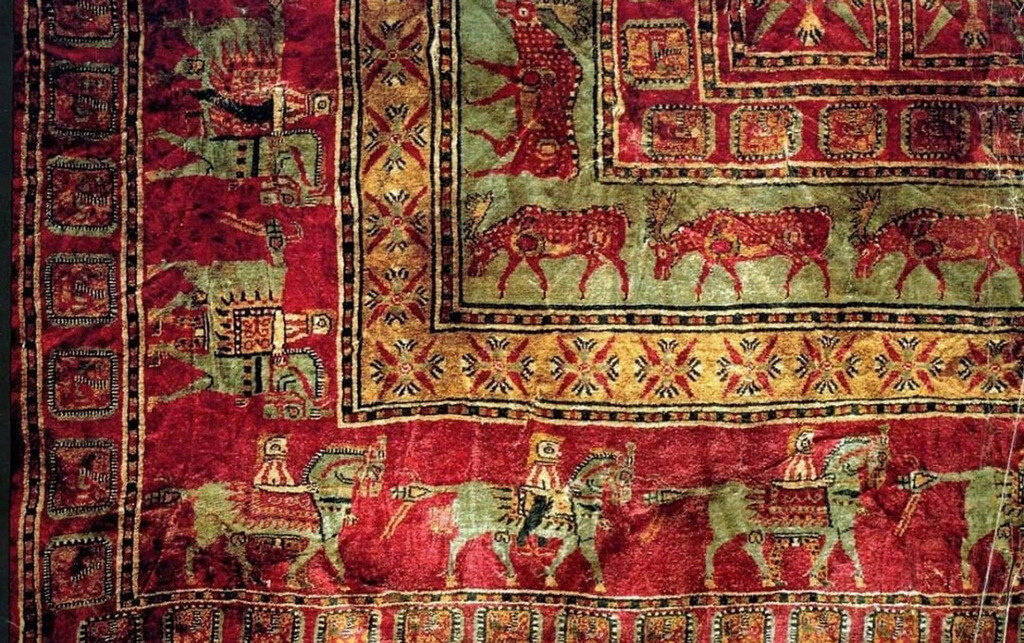
The design of the Pazyryk Carpet reflects a sophisticated visual language. The central field is organized into a geometric arrangement of repeated motifs, including stylized floral or star-like forms. The dominant red background is complemented by secondary colors such as yellow, blue, and white, creating a balanced and harmonious composition .
The borders provide further insight into the cultural context of the carpet. One border features mounted riders in procession, whose clothing and posture bear similarities to figures seen in Persian reliefs. Another border includes deer, animals native to the Altai region and closely associated with the steppe environment.
This combination of motifs suggests a synthesis between imperial artistic influences and local nomadic traditions. As Aslanapa notes, such a synthesis is best understood within the framework of a large political and cultural network, likely connected to the broader sphere of the Hun world.
The Continuity of a Tradition
One of the most valuable aspects of the Pazyryk Carpet is what it reveals about the development of carpet weaving over time. It does not stand alone as an isolated masterpiece, but forms part of a longer historical sequence.
Aslanapa outlines this continuity through a series of later discoveries. Following the Pazyryk example, smaller carpet fragments found in East Turkestan, particularly in sites such as Lou-Lan, date from the 3rd to 6th centuries and demonstrate simpler but related techniques. Later, fragments discovered in Fustat (Old Cairo), associated with early Islamic periods, show further development in both design and structure. These are followed by the well-known Seljuk carpets of Anatolia, which establish the foundation of the classical Turkish carpet tradition.
This sequence creates a clear historical progression in which techniques, motifs, and materials evolve while maintaining a recognizable continuity. Within this framework, the Pazyryk Carpet can be understood not as an isolated origin point, but as one of the earliest surviving milestones in a much longer tradition.
From an Archaeological Object to a Living Tradition
Today, the Pazyryk Carpet is preserved in the Hermitage Museum in St. Petersburg, where it is displayed under carefully controlled conditions. It is no longer part of a living environment, but an object of study and preservation.
However, the techniques and principles it represents have not been lost. The symmetrical knot, the use of natural materials, and the geometric organization of patterns all remain part of traditional carpet weaving in Anatolia.
For a modern observer, this creates an important shift in perspective. A handmade carpet seen in Istanbul is not simply a decorative object or a souvenir. It is part of a long and continuous tradition that extends back more than two thousand years.
What This Means for Today’s Buyer
Understanding the historical depth of Turkish carpet weaving changes the way modern rugs are perceived. Instead of evaluating them only in terms of color, size, or price, it becomes possible to recognize the underlying structure that connects them to earlier examples.
Elements such as knot type, material quality, and design composition are not random features. They are the result of a tradition that has been refined over centuries. Recognizing these elements allows a buyer to distinguish between pieces that are part of this tradition and those that are not.
This perspective also helps clarify one of the most common points of confusion for visitors: the difference between a decorative product and a handmade textile rooted in historical practice. While both may appear visually appealing, only one carries the technical and cultural continuity described above.
Continue Exploring Turkish Rugs in Istanbul
The Pazyryk Carpet offers a starting point for understanding the depth and continuity of Turkish carpet weaving. However, applying this knowledge in a real-world context—especially in a city like Istanbul—requires a different kind of guidance.
If you would like to learn how to recognize authentic handmade rugs, understand pricing, and navigate the many options available in Istanbul, you can continue with the main guide: Where to Buy Turkish Rugs in Istanbul (2026 Expert Guide)