Buying a Turkish rug in Istanbul is one of those experiences that feels both exciting and uncertain at the same time.
On one hand, you are surrounded by a centuries-old tradition. Carpets that carry the visual language of Anatolia, shaped by nomadic life, refined in Ottoman workshops, and still present today in the markets of the city. On the other hand, you are stepping into an environment where everything moves quickly—colors, patterns, prices, and decisions.
For many travelers, this contrast creates a simple question:
Where do I even begin?
After more than 20 years of guiding in Istanbul, I have walked into countless carpet shops with visitors from all over the world. I have seen the same hesitation again and again—not because people lack taste, but because they lack clarity. Too many choices, too many unknowns, and too much conflicting advice.
This guide is designed to solve that problem.
It does not try to turn you into a collector or a specialist. Instead, it gives you just enough understanding to move with confidence. You will learn how to recognize the difference between a handmade rug and a machine-made one, how to understand materials and patterns, where to go in the city, and—perhaps most importantly—how to avoid the common mistakes that lead to regret.
Along the way, I also draw on the work of Oktay Aslanapa, one of the most respected scholars of Turkish carpet art, to connect what you see in today’s shops with the deeper history behind it.
Because once you understand that connection, something shifts.
You stop feeling like a tourist trying to make a purchase…
…and start seeing what is actually in front of you.
Why Turkish Rugs Are More Than Just Souvenirs
Before looking at types, materials, or where to buy, it helps to understand what makes Turkish rugs different in the first place.
Because once you see them not just as decorative objects, but as part of a long and continuous tradition, everything else in this guide begins to make much more sense.
A Tradition Rooted in Anatolia
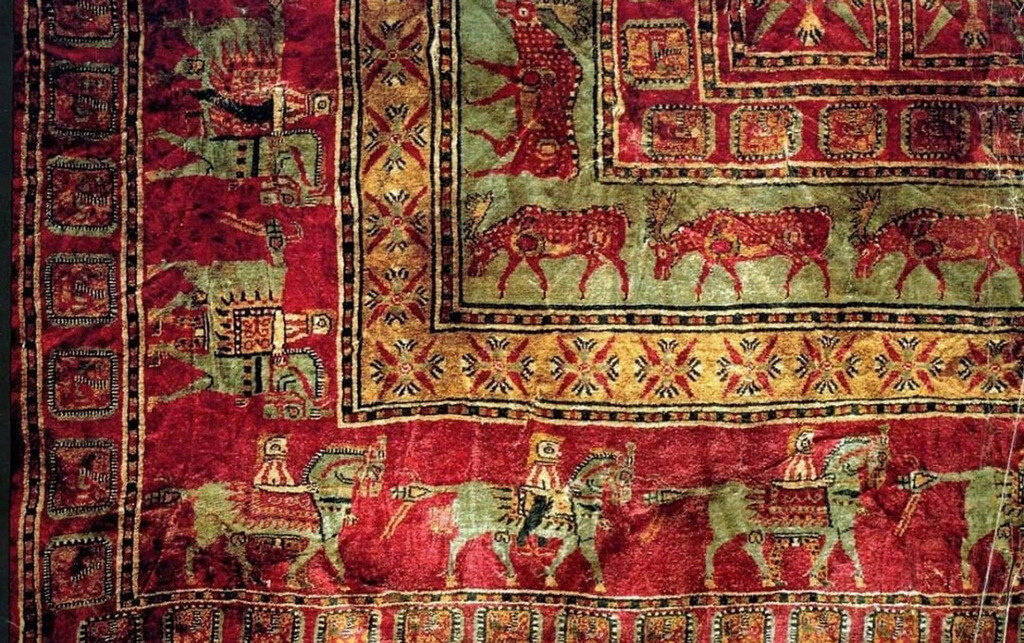
When most visitors step into a carpet shop in Istanbul, they see colors, patterns, and prices. What they often don’t immediately see is the depth of time behind those objects.
The tradition of Turkish carpet weaving stretches back more than two thousand years. The oldest known knotted carpet in the world, discovered in the Altai Mountains, is generally dated to around the 3rd–2nd century BC, although some scholars place it even earlier. What makes this discovery remarkable is not only its age, but also its extraordinary technical sophistication. The Pazyryk Carpet was woven with the Gördes (symmetrical Turkish) knot and displays an extraordinarily high knot density, described by art historian Oktay Aslanapa as unmatched even in later centuries.
This detail is not just academic. It tells us something essential: from the very beginning, carpet weaving in Turkic cultures was not a primitive craft, but a highly developed art form.
This tradition continued as Turkic peoples moved westward into Anatolia, where it reached a new level under the Seljuks. Although no carpets have survived from the Great Seljuk period, the monumental carpets of Konya—associated with the Alaeddin Mosque—became the foundation of a tradition that continued for seven centuries of uninterrupted development, constantly producing new forms while preserving its technical identity.
For a modern buyer, this continuity is crucial. A handwoven Turkish rug is not a revived tradition or a nostalgic reproduction. It is part of a living lineage that has evolved over centuries without losing its structural logic.
This is why Turkish carpets stand apart. Not simply because they are old, but because the same knotting system, compositional discipline, and visual language have been carried forward with remarkable consistency.
From Nomadic Tribes to Ottoman Palaces
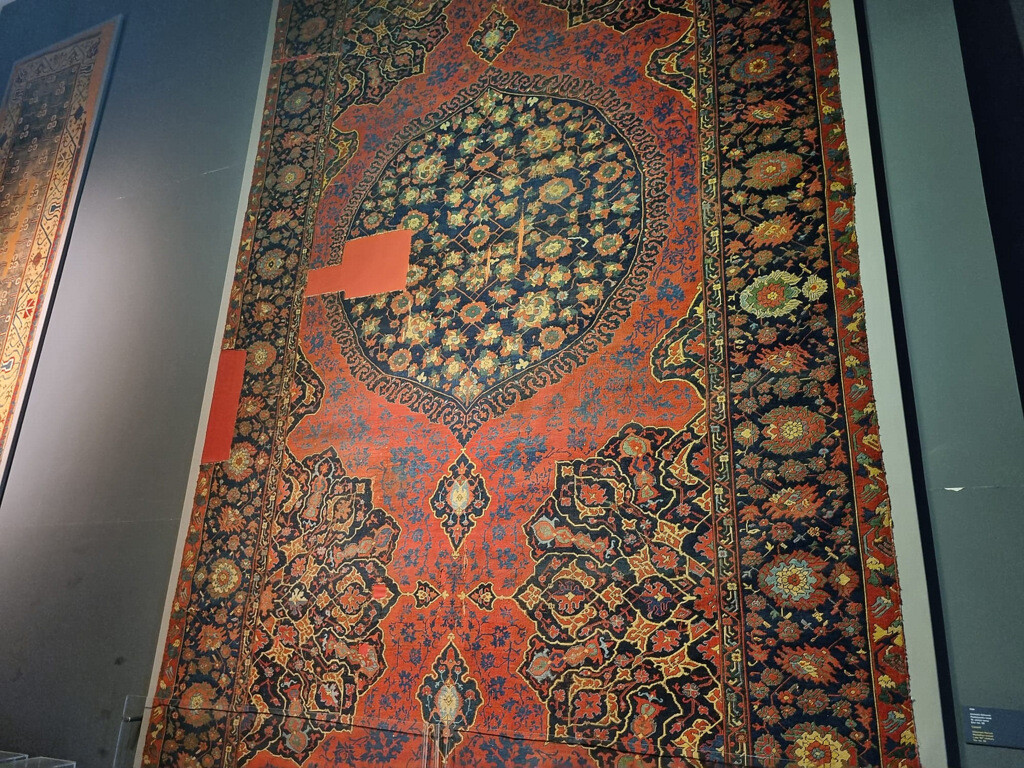
The earliest Turkish carpets were not luxury objects. They were created by nomadic communities for practical purposes such as insulation and portability. As a result, their designs were bold, geometric, and highly structured. Repeating patterns, strong borders, and stylized motifs reflected both the constraints of portable looms and the symbolic language of tribal life.
This visual world began to change in the 16th century, particularly after the Ottoman Empire incorporated major artistic centers such as Tabriz (1514) and Cairo (1517). These conquests brought new artistic traditions into the Ottoman sphere and led to the emergence of what we now call Ottoman court carpets.
Unlike their tribal predecessors, these carpets featured flowing compositions, naturalistic floral motifs, and more complex spatial organization. Technically, they also differed. While traditional Anatolian carpets were woven with the symmetrical Gördes knot, many palace carpets adopted the asymmetrical (Sine) knot, producing a softer and more velvety texture. The conquest of Cairo in particular introduced the influence of Mamluk carpet traditions, shaping the materials, color palette, and technical refinement of these imperial pieces.
This transformation explains one of the most common points of confusion for visitors today. In a single shop in Istanbul, carpets can appear radically different from one another. Some are bold and geometric, others are refined and floral. This is not inconsistency, but history made visible: a transition from a nomadic, symbolic aesthetic to an imperial, courtly one.
Between these two worlds lies another important layer. Anatolian carpets, especially those later classified as Holbein and Lotto types, appear frequently in 15th and 16th century European paintings. These were not isolated local products, but internationally recognized luxury objects. We will return to these carpets in more detail later, but even at this stage, it is worth noting that Turkish carpets were already part of a global visual culture centuries ago.
Why Every Rug Tells a Story
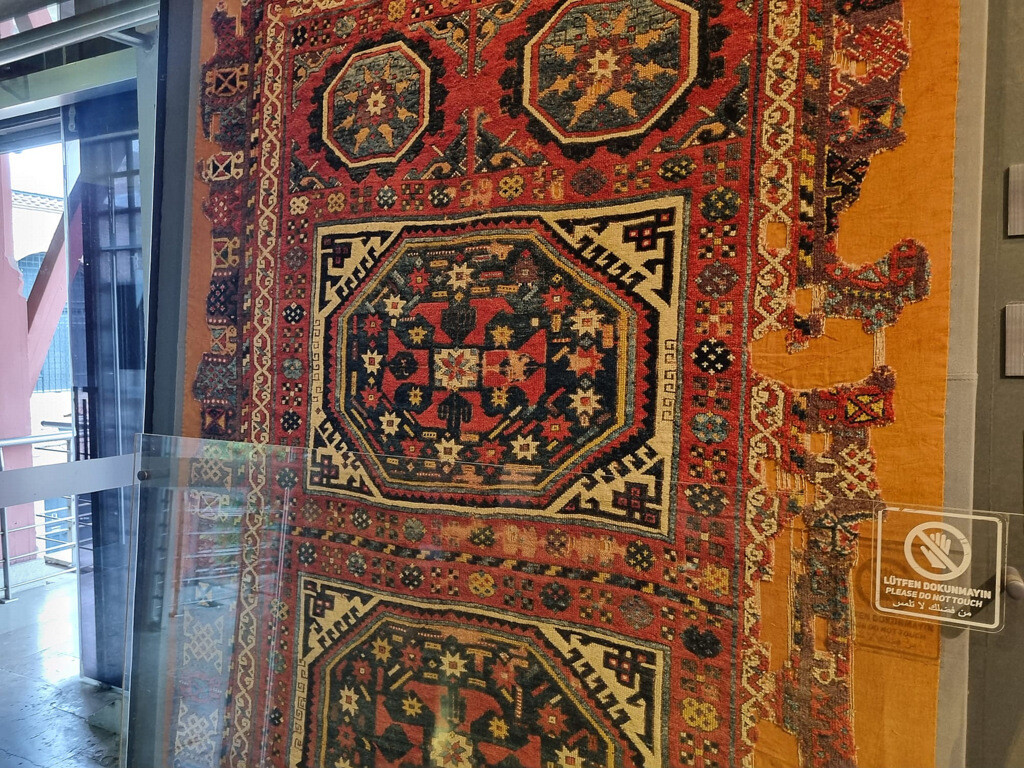
One of the most common reactions among travelers who buy a Turkish rug is a sense that they have acquired something meaningful, even if they cannot fully explain why.
This impression has deep historical roots. In early Anatolian weaving traditions, motifs were not purely decorative. They functioned as a visual language. Many of the women who produced these carpets did not leave written texts, but they expressed ideas, beliefs, and experiences through patterns and compositions.
In some examples, we see symmetrical arrangements of birds around a central tree, suggesting continuity or protection. In others, especially in later medieval Anatolian carpets, more dynamic imagery appears, including stylized animals and mythological confrontations such as the struggle between a dragon and a phoenix-like creature. A well-known example of this type, identified in a 15th-century Anatolian carpet later acquired for European collections, is now preserved in the Berlin Museum collections, where this symbolic narrative can still be observed today.
Even when figurative imagery disappears, meaning does not. The wide borders of many early carpets, often derived from Kufic calligraphic forms, show how closely weaving was connected to other artistic traditions. In this sense, carpets were not only visual objects but also structured compositions that could be “read” within a shared cultural language.
This is why two rugs that appear similar at first glance can feel very different when examined more closely. One may be purely decorative, while another carries layers of cultural memory and intention.
For a modern visitor, recognizing this difference changes the experience of buying a carpet. Instead of focusing only on price or appearance, attention gradually shifts toward structure, meaning, and craftsmanship. From that point on, the carpets in front of you begin to look less like merchandise and more like the result of a long and continuous tradition.
How to Understand Turkish Rugs Before You Buy
Before stepping into a carpet shop, it helps to understand what you are actually looking at.
Because once you know how to read a rug — materials, structure, and craftsmanship — the entire experience becomes much clearer, and many of the common uncertainties simply disappear.
Hand-Knotted vs Machine-Made Rugs
One of the first things you will hear in any carpet shop in Istanbul is the phrase “handmade.” However, not everything labeled as handmade reflects the same level of craftsmanship, and for a buyer, understanding this distinction is essential.
Traditional Turkish rugs are woven using the Gördes (symmetrical) knot, a technique in which each knot is tied around two warp threads. This creates a structurally strong and long-lasting textile. It is the same knotting system used in some of the earliest known carpets, and one of the reasons why certain historical examples have survived for centuries in remarkably good condition.
Machine-made rugs operate on a completely different logic. They are produced on industrial looms, often with synthetic materials, and rely on speed and uniformity rather than durability or individuality. From a distance, they can look convincing, but the difference becomes clear upon closer inspection.
The most reliable way to tell the difference is to turn the rug over. In a hand-knotted rug, the pattern is visible on the back with slight irregularities in the knots, reflecting the human hand behind the work. In machine-made rugs, the back often appears overly perfect, sometimes with a mesh or adhesive structure, and the fringe is typically sewn on afterward rather than being an extension of the rug itself.
This is not a minor detail. A hand-knotted rug is designed to last for decades, often generations. A machine-made rug is not.
Wool vs Silk vs Cotton
Another key factor that shapes both the appearance and function of a rug is the material used.
Historically, material choice in Turkish carpets was closely tied to function. Nomadic communities relied primarily on wool, which is durable, resilient, and naturally suited for everyday use. Wool rugs are warm, forgiving, and age gracefully. Over time, they develop a soft sheen and a character that reflects use rather than wear.
In contrast, silk emerged as a material associated with refinement and prestige, particularly in later Ottoman periods and in centers such as Hereke. Silk allows for extremely fine knotting and intricate designs, but it is also more delicate. For this reason, silk rugs are often treated as display pieces rather than everyday floor coverings.
Cotton, on the other hand, is usually not the visible surface of the rug but forms its structural foundation. It is used in the warp and weft to stabilize the rug and maintain its shape over time.
For a modern buyer, the distinction is practical. A wool rug is something you live with. A silk rug is something you preserve. Cotton is what holds everything together.
Natural Dyes vs Chemical Dyes
Color is often what attracts people to a rug first, but not all colors are created in the same way.
Traditional Turkish carpets were dyed using natural sources such as plants, roots, and minerals. Deep reds derived from madder root, blues from indigo, and warm yellows from various botanical sources created a palette that was both rich and harmonious. These dyes do not remain static over time. Instead, they soften gradually, giving older rugs their distinctive, slightly muted elegance.
One of the most telling signs of natural dyeing is something known as abrash, a subtle variation in tone within the same color field. Rather than being a flaw, abrash is evidence of hand-dyeing processes and adds depth and authenticity to the rug.
Chemical dyes, which became more common in later periods, offer stronger and more uniform colors. While this can be visually striking, it often lacks the depth of natural dyes and, in some cases, may lead to color instability if not properly fixed.
For a buyer, the key is not to assume that brighter means better. In many cases, the slightly uneven, softer tones of a naturally dyed rug are what give it long-term aesthetic value.
Knot Density (What Actually Matters)
Knot density is one of the most frequently mentioned and most misunderstood aspects of carpet quality.
It is true that a higher knot count generally allows for more detailed patterns and finer execution. Historical examples show a wide range of densities, from relatively coarse tribal weavings to extremely fine pieces. However, focusing on numbers alone can be misleading.
In many shops, especially in tourist areas, sellers may emphasize high knot counts as a primary selling point. While this can be relevant for silk rugs, where fine detail is expected, it is far less meaningful for traditional Anatolian carpets.
A tribal or village rug is not meant to compete in precision with a silk court carpet. Its value lies in its character, composition, and authenticity rather than numerical density. A lower knot count in such rugs is not a defect, but a reflection of the tradition it belongs to.
What matters more than the number itself is how the rug feels as a whole. Are the knots tight and consistent? Does the pattern read clearly? Does the structure feel solid?
In other words, knot density is a useful indicator, but only when understood in context. Without that context, it becomes just another number.
Types of Turkish Rugs You Will See in Istanbul
Walking into a carpet shop in Istanbul can feel overwhelming at first. Dozens of rugs are unfolded in front of you, each with different colors, textures, and patterns. Without a basic framework, it is almost impossible to understand what you are looking at, let alone make a confident decision.
In reality, most rugs you will encounter fall into a few main categories. Once you understand these, the entire experience becomes clearer. You begin to recognize not just visual differences, but also the historical and cultural context behind each piece.
Hereke Rugs (Luxury Silk Masterpieces)
Among all Turkish carpets, Hereke rugs represent the highest level of refinement and technical precision. They originated in the 19th century, when imperial workshops were established in the town of Hereke to produce carpets for palaces such as Dolmabahçe.
When people hear “Hereke,” they often think of pure silk. In reality, the story is more nuanced.
The large, room-sized carpets woven for the floors of Dolmabahçe Palace were typically made of high-quality wool on a cotton foundation, designed for durability as well as visual impact. At the same time, the Hereke workshops also produced exceptionally fine silk-on-silk carpets, which are today considered among the most valuable examples of Turkish weaving.
What makes Hereke truly remarkable is not just the material, but the technique. Despite their delicate appearance and extremely fine detail, authentic Hereke rugs are traditionally woven using the symmetrical Gördes (Turkish) knot. Achieving such high knot density with a double knot is a reflection of extraordinary craftsmanship.
The result is a surface that can feel almost like fabric, especially in silk pieces, with intricate floral compositions, medallions, and finely detailed borders.
This is why Hereke rugs are often seen not simply as floor coverings, but as collectible artworks. Prices vary significantly depending on material and knot density, but fine silk examples are among the most valuable rugs you will encounter in Istanbul.
For a buyer, one simple observation can be helpful: authentic silk rugs tend to reflect light differently depending on the viewing angle, creating a subtle change in color. This is not a trick of lighting, but a natural property of silk.
Oushak (Uşak) Rugs (Soft Colors, Large Patterns)

Oushak rugs, produced in Western Anatolia since at least the 16th century, offer a completely different aesthetic. Where Hereke rugs emphasize detail and precision, Oushak carpets are defined by scale, softness, and balance.
Their patterns are typically large and open, often centered around medallions or repeating star motifs. Colors tend to be muted—soft reds, faded blues, and warm neutrals—which makes them particularly compatible with modern interiors.
Historically, these rugs evolved from an earlier tradition of geometric Anatolian carpets, including those later classified in European art history as Holbein and Lotto types. Over time, this tradition developed into the classical Oushak style, which became one of the most recognizable carpet groups of the Ottoman period.
Within this tradition, several subtypes can still be identified today. Medallion Uşak rugs, sometimes reaching very large dimensions, are organized around a dominant central form that gives the composition a sense of scale and balance. Star Uşak rugs, which are rarer, rely on repeating geometric units to create a more dynamic rhythm across the surface. Another group, often referred to as “bird rugs” (kuşlu halı), features lighter backgrounds and more delicate, refined compositions.
For modern buyers, Oushak rugs often feel more approachable than highly intricate silk carpets. They do not dominate a space, but rather integrate into it. If you are looking for something that feels both traditional and adaptable to contemporary interiors, this is often the most natural choice.
Kilims (Flat-Woven Tribal Rugs)
Kilims differ fundamentally from knotted carpets. Instead of being created through knots, they are produced using a flat-weaving technique, resulting in a lighter, thinner textile without pile.
This makes them highly practical. Kilims are easy to transport, reversible, and historically served multiple functions in nomadic life, from floor coverings to wall hangings and storage textiles.
What is often overlooked is the technical and regional diversity within this category. Different weaving techniques such as cicim, zili, and sumak create variations in texture and structure, while regions across Anatolia developed their own distinct visual languages. For this reason, kilims should not be seen as a simplified alternative to carpets, but as a parallel tradition with its own depth and history.
Visually, kilims are defined by sharp geometric patterns and bold color contrasts. Because the technique does not allow for curved lines in the same way as knotted carpets, designs tend to be more angular and direct.
For today’s buyers, kilims offer an accessible entry point into Turkish textile traditions. They are generally more affordable than knotted rugs, but their real strength lies in their versatility and strong visual identity.
Anatolian Tribal Rugs
If Hereke rugs represent refinement and Oushak carpets represent balance, Anatolian tribal rugs represent character.
These are the closest continuation of the older weaving traditions rooted in village and nomadic life. They are typically made using wool, preserving the structural integrity that defines Turkish carpets.
Unlike court-produced or workshop-designed rugs, tribal pieces are often more irregular. Patterns may not align perfectly, and colors can vary slightly within the same field due to natural dye processes. This is not a flaw, but part of their identity.
Many of these rugs carry regional signatures. Places like Bergama, Konya, or Milas developed distinct visual languages, often including symbolic motifs such as stylized plants, protective elements, or abstracted life forms.
Some traditions, particularly in regions like Bergama, preserve elements that can be traced back to earlier Anatolian and even Seljuk design systems. In this sense, certain tribal rugs are not isolated expressions, but part of a long visual continuity connecting medieval geometric carpets to later village weaving traditions.
For collectors and more experienced buyers, these rugs are often the most compelling. They feel less standardized and more personal, reflecting the hand and intention of the weaver rather than a fixed design template.
Modern vs Traditional Designs
In recent years, a new category has emerged that blends traditional techniques with contemporary aesthetics. These rugs are still handwoven, often using natural materials and classical knotting methods, but their designs are adapted to modern tastes.
Instead of historical motifs, you may see abstract compositions, minimal patterns, or muted monochrome palettes. The goal is not to replicate the past, but to reinterpret it in a way that fits contemporary interiors.
This shift responds to a common concern among modern buyers: the fear that traditional carpets may feel too heavy or stylistically restrictive in a current living space. By maintaining the craftsmanship while updating the design language, these rugs offer a balanced alternative.
In Istanbul, some shops—particularly in and around the Grand Bazaar—have specialized in this approach, offering pieces that combine traditional techniques with modern design sensibilities.
For someone who appreciates the idea of handmade textiles but prefers a cleaner visual aesthetic, this category provides a way to engage with the craft without committing to a historically dense style.
Where to See the Best Antique Rugs Before You Buy
One of the smartest things you can do before entering a carpet shop in Istanbul is to spend some time with museum-quality pieces. For most visitors, this sounds like a cultural detour. In reality, it is one of the best ways to become a more confident buyer.
The biggest anxiety in carpet shopping is not usually taste. It is trust. People worry about authenticity, price, age, and whether they are being shown something genuinely meaningful or simply something presented well. Museums solve part of this problem by giving you a visual reference library. Once you have seen great carpets in a historical setting, your eye becomes sharper. You begin to notice quality, structure, color harmony, and design logic much more naturally.
In other words, these museums do not just show you beautiful objects. They teach you what beauty and quality look like in this tradition.
Turkish and Islamic Arts Museum
If you visit only one museum before buying a rug in Istanbul, this should probably be the one.
Housed in the former palace of Ibrahim Pasha, the Turkish and Islamic Arts Museum preserves some of the most important surviving examples of early Anatolian carpets, especially the monumental Seljuk rugs associated with Konya. These are not small decorative pieces. They represent the royal scale of medieval Turkish weaving, with some examples originally reaching enormous dimensions and knot counts that reflect a remarkably advanced technical tradition.
What makes this museum so valuable for a buyer is that it allows you to see the core language of early Turkish carpets in a concentrated form. Strong geometry, disciplined composition, monumental borders, and the visual power of the Gördes knot all become easier to understand when you are standing in front of original pieces rather than hearing about them in a shop.
This is also one of the best places to understand how later European art history categories such as Holbein and Lotto carpets connect back to Anatolian weaving traditions. Even if those names are more familiar from museum books and Renaissance paintings, the deeper visual grammar behind them belongs to this world. Seeing that relationship in person gives you a stronger foundation when sellers later begin naming styles and regions.
For many visitors, this museum quietly changes the whole shopping experience. After seeing these pieces, you stop reacting only to color or price and begin paying attention to structure, proportion, and authority.
Vakıflar Carpet Museum (Hagia Sophia Imaret)
Often overlooked by casual visitors, the Vakıflar Carpet Museum near Hagia Sophia is one of the most rewarding places in Istanbul for anyone who wants to understand the deeper layers of Turkish carpet history.
Unlike larger museum collections, this space offers a more focused and intimate encounter with historical pieces. Many of the carpets displayed here were originally donated to mosques across Anatolia, which means they carry not only artistic value but also a sense of social and religious context.
One of the most striking aspects of the collection is the presence of animal-figured carpets dating back to the 15th century, where stylized birds, geometric creatures, and even mythological confrontations reflect an older symbolic language rooted in nomadic traditions. These pieces help explain how motifs that may appear abstract in a shop are actually part of a long visual and cultural continuity.
For a buyer, this museum plays a subtle but important role. It trains you to see beyond surface decoration. After visiting, geometric forms and repeating patterns begin to feel less random and more intentional, as part of a visual language that evolved over centuries.
It is also one of the rare places in the historic peninsula where you can step away from the crowds and engage with textile history in a quieter, more focused setting.
Topkapı Palace Collections
If the Turkish and Islamic Arts Museum reveals the foundations of Anatolian carpet art, Topkapı Palace shows you how that tradition was transformed at the imperial level.
The collections here make the most sense when viewed in the context of the 16th century, especially after the Ottoman conquests of Tabriz in 1514 and Cairo in 1517. These events introduced new artistic influences and played a major role in reshaping the visual language of carpets within the empire.
As noted by art historian Oktay Aslanapa, this period marks the emergence of Ottoman court carpets as a distinct category. Designs become more fluid, floral, and refined, moving away from strict geometric compositions toward a more naturalistic and imperial aesthetic. Technically, many of these carpets also differ, using the asymmetrical Sine knot and reflecting influences from Persian and Mamluk traditions in both texture and color sensibility.
For buyers, Topkapı provides a crucial reference point. When a seller describes a carpet as “Ottoman palace style,” this is the level of refinement you should have in mind. The comparison is not about whether a rug has flowers, but whether the overall composition feels balanced, elegant, and historically grounded.
Seeing these pieces in their original cultural context makes it much easier to distinguish between authentic stylistic lineage and superficial imitation.
Dolmabahçe Palace and Hereke Legacy
Dolmabahçe Palace belongs to a later chapter in Ottoman history, but for understanding Hereke carpets, it is one of the most revealing places in Istanbul.
In the 19th century, the Ottoman court established specialized workshops in Hereke to produce carpets worthy of the empire’s new palatial interiors. These workshops created some of the most refined textiles ever produced in the Ottoman world, combining technical precision with a level of luxury that still defines the name Hereke today.
What is often overlooked, however, is that the monumental carpets woven for the floors of Dolmabahçe Palace were primarily crafted from high-quality wool on a cotton foundation, designed to withstand large ceremonial spaces. At the same time, the Hereke workshops also produced exceptionally fine silk carpets, which represent the most delicate and collectible side of this tradition.
This distinction is important. In many shops, “Hereke” is often associated directly with silk, but in reality, the tradition includes both durable palace-scale carpets and highly refined silk pieces.
At Dolmabahçe, this balance becomes easier to understand. You see carpets designed not only for visual impact, but also for function, scale, and long-term use within imperial interiors.
This perspective is especially valuable for buyers who are unsure about silk rugs. Many people wonder why one silk carpet can be dramatically more expensive than another. Seeing the broader Hereke tradition in its original context helps answer that question.
Once you have experienced that level of craftsmanship, it becomes much easier to evaluate what is being offered to you in the market.
Where to Buy Turkish Rugs in Istanbul
Let’s be honest — buying a Turkish rug in Istanbul can feel overwhelming at first.
The city is full of shops, markets, and confident sales pitches. Without a clear sense of where to go, the experience can quickly turn from exciting to exhausting. But once you understand how the rug-selling landscape is structured, everything becomes much easier to navigate.
Before getting into specific recommendations, there is one important reality to keep in mind. Traditional carpet weaving is slowly becoming a rarer craft. Fewer artisans are willing to invest the years required to master it, and production has gradually shifted toward countries where labor is cheaper. While these rugs may look similar at first glance, they rarely carry the same structural integrity or cultural depth.
This is why genuinely handmade Turkish rugs—especially classical types such as Hereke and Oushak—are becoming both rarer and more valuable over time.
Most rug shops in Istanbul are concentrated in two main areas: the Grand Bazaar and the Sultanahmet district. Understanding the difference between these environments is the first step toward having a good experience.
Grand Bazaar (Pros & Cons)
The Grand Bazaar is one of the oldest and largest covered markets in the world, and stepping inside it is an experience in itself.
The biggest advantage here is variety. Within a single complex, you can see hundreds of shops and thousands of carpets. Historic courtyards such as Zincirli Han still carry the atmosphere of centuries-old trade, and for many visitors, this setting is part of the appeal.
However, this density comes with a downside. For someone without prior knowledge, it can be difficult to distinguish between truly handmade pieces and more commercial products. Sales approaches can also be more intense, and many visitors mention feeling pressured to make decisions quickly.
For this reason, the Grand Bazaar is best approached with a clear plan. It is an excellent place to explore and compare, but not always the easiest place to build trust on your first encounter.
Sultanahmet Area Shops
The Sultanahmet area offers a very different experience.
Located around Hagia Sophia, Topkapı Palace, and the Blue Mosque, this part of the city has a more open and slower rhythm compared to the Grand Bazaar. Shops here tend to be smaller, and interactions are often more relaxed.
For many travelers, this creates a more comfortable environment. Instead of being surrounded by dozens of competing sellers, you have the chance to sit down, look at a smaller selection, and actually talk about what you are seeing.
Another practical advantage is proximity. Since most visitors spend a significant amount of time in Sultanahmet, returning to a shop after thinking things through becomes much easier.
Outside the Tourist Zones (Hidden Gems)
Some of the best carpet-buying experiences in Istanbul happen just outside the main tourist hubs.
Areas around Nuruosmaniye and the quieter streets behind Sultanahmet often host shops where the atmosphere feels noticeably more relaxed. With less constant foot traffic, sellers tend to focus more on conversation and guidance rather than quick sales.
This does not necessarily mean lower prices, but it often means a better experience. You are more likely to be shown pieces that match your taste rather than what needs to be sold quickly.
My Recommended Turkish Rug Shops in Istanbul
Over the years, I have visited countless carpet shops in Istanbul, both personally and with my tour guests. While many places offer beautiful pieces, only a few consistently combine quality, honesty, and a genuinely welcoming atmosphere.
The shops below are not random recommendations. They are places I know well and trust, and where I feel comfortable sending visitors who may be experiencing this world for the first time.
Noah’s Ark Carpet Shop (Trusted Experience)
If you ask me where to buy a Turkish rug in Istanbul, my first answer will almost always be Noah’s Ark Carpets.
Located on Ticarethane Street, just off Divanyolu and next to Sura Hotel, this small shop has built a strong international reputation over the years, with mentions in publications such as National Geographic and Outside Magazine.
Despite that recognition, the atmosphere remains warm, local, and refreshingly unpretentious.
Noah’s Ark specializes in nomadic-style carpets and colorful kilims, making it an excellent choice for those who are drawn to more authentic, character-driven pieces.
What truly sets this place apart, however, is the people behind it — Abdullah Doğan and the Yıldız brothers, Yusuf and Hamza.
Disclosure: I have a referral arrangement with Noah’s Ark Carpets. My recommendation is based on my own experience and on feedback from guests I have sent there over the years.
Address: Sultanahmet Divanyolu Avenue, Ticarethane Street. No:5 Fatih/İstanbul
Şengör Carpet
If Noah’s Ark represents warmth and accessibility, Şengör Carpet represents continuity and tradition.
Located on Takkeciler Street inside the Grand Bazaar, this shop has been operated by the same family for more than a century.
One of the most remarkable aspects of Şengör is that Şemsettin Şengör, now in his 90s, is still connected to the shop and its collection. This creates a rare sense of continuity that is difficult to find in modern retail environments.
The shop itself is not flashy, but it houses a large and carefully curated inventory. What you find here is not a staged experience, but decades of accumulated expertise.
For buyers who value heritage and long-term trust, this is one of the most reliable places in the city.
Address: Beyazıt (Grand Bazaar), Takkeciler Sk. No: 65/75/83 Fatih/İstanbul
Other Shops Worth Visiting
Different buyers look for different things, and Istanbul offers options that reflect a wide range of tastes.
Şişko Osman, located in Zincirli Han inside the Grand Bazaar, is one of the most legendary names in the carpet world. Known among collectors and high-end buyers, this is a place where you encounter rare and exceptional pieces.
Punto Carpet, near Nuruosmaniye Gate, offers a more polished retail experience with a wide selection of wool, cotton, and silk rugs. It is a good option if you want to compare different styles in a structured setting.
Dhoku Rugs, also located on Takkeciler Street, represents a more contemporary direction. Traditional weaving techniques are combined with modern, minimalist design, making these rugs especially appealing for modern interiors.
Final Note
At the end of the day, buying a Turkish rug is not about finding the “best” shop, but about finding the place where you feel comfortable enough to take your time and make a thoughtful decision.
Once that happens, the experience becomes much more than a transaction. It becomes part of your journey in Istanbul.
The Honest Truth About Buying Turkish Rugs
By the time most visitors step into a carpet shop in Istanbul, they are not just curious—they are cautious.
You may have already read online forums, watched videos, or heard stories from other travelers. Many of these stories focus on the same concerns: “Am I being overcharged?”, “Is this really Turkish?”, “What if they swap my rug after I leave?”
These fears are real. But they are also manageable—once you understand how the system actually works.
This section is not here to sell you anything. It is here to give you clarity, so you can walk into any carpet shop in Istanbul feeling informed rather than uncertain.
Is It Really Turkish or Imported?
This is one of the most common and most misunderstood questions.
Traditionally, Turkish carpets are defined not only by where they are sold, but by how they are made. The use of the Gördes (symmetrical) knot, the structure of the weave, and the design language all play a role in defining what we call a “Turkish rug.”
However, the reality today is more complex.
Because of rising production costs and the decline of traditional weaving in many regions, a significant portion of rugs sold in Istanbul are now produced in countries such as India, Afghanistan, or China. This does not automatically make them inferior. In many cases, these rugs are still handmade and can be of good quality.
What matters is transparency.
In the shops I personally recommend, such as Noah’s Ark or Şengör, this distinction is usually explained openly. You may be shown a rug and told directly where it was made. That honesty is far more important than the label itself.
A rug does not need to be woven in Turkey to be meaningful for you. What matters is whether it fits your taste, your space, and your expectations. At the same time, if a shop claims that every single piece is a rare “pure Turkish Hereke” available in all sizes and price ranges, it is reasonable to question that narrative.
Understanding this balance removes a lot of unnecessary anxiety. You are not looking for a perfect label—you are looking for the right piece.
How to Handle the “Carpet Show” Pressure
One of the most memorable parts of the carpet-buying experience in Turkey is the presentation itself.
You sit down, you are offered tea, and one rug after another is unfolded in front of you. At some point, many visitors begin to feel uncomfortable. There is a sense that they are now expected to buy something.
This is where most of the anxiety comes from.
It is important to understand that this process is not a trap. It is part of the culture of selling carpets. Showing multiple pieces, opening them one by one, and explaining their details is simply how this trade works.
Drinking tea does not create an obligation.
Asking to see more rugs is not a commitment.
And leaving without buying anything is not considered rude.
Good shop owners understand that carpet buying is a slow decision. If you feel pressured, it is usually a sign that you are not in the right environment—not that you are doing something wrong.
Once you realize this, the entire experience becomes more relaxed. You are no longer trying to escape the situation. You are simply observing and learning.
Bargaining: What is a Fair Price?
Bargaining is often presented as a game, but in reality, it is closer to a conversation.
There is no universal formula. Advice such as “start at 25% of the price” may sound practical, but it rarely reflects how things actually work in a meaningful transaction.
The price of a rug depends on multiple factors: material, knot density, size, design complexity, and sometimes age. Two rugs of similar size can differ dramatically in price because they belong to completely different categories of craftsmanship.
A more useful way to think about bargaining is this: it is a process of finding a point where both sides feel comfortable.
If a price drops too quickly and too dramatically, it is reasonable to question how it was set in the first place. At the same time, insisting on pushing the price as low as possible can turn the interaction into a purely transactional exchange, which is not how this tradition has historically functioned.
In well-run shops, negotiation is usually calm, respectful, and gradual. It is not about “winning,” but about reaching a balance between value and budget.
Shipping Safety (Will My Rug Be Switched?)
This is one of the most persistent fears discussed in travel forums.
The idea is simple: you choose a beautiful rug in the shop, but the one that arrives at your home is not the same piece.
While stories like this exist, they are not the norm—especially when you are dealing with established and reputable shops.
Still, it is a concern that deserves a practical answer.
If you want additional peace of mind, there are simple steps you can take. You can photograph the rug clearly before it is packed, including close-up details. Some buyers even sign a small part of the back or take a photo together with the seller on the day of purchase.
More importantly, trusted shops typically work with international shipping companies such as DHL or UPS and provide insured delivery. This creates a documented process that significantly reduces risk.
In the end, shipping is not something you need to fear—but it is something you should approach with awareness.
Avoiding Buyer’s Regret
Perhaps the most overlooked risk is not being overcharged or misled, but simply making the wrong choice.
Many travelers buy a rug while still under the influence of the moment—the atmosphere, the lighting, the excitement of being in Istanbul. Everything feels right in the shop. But once the rug arrives at home, it may not feel the same.
This is not because the rug changed. It is because the context did.
The best way to avoid this is surprisingly simple: slow down.
Take your time. Look at multiple pieces. Step outside and come back later if needed. Try to imagine the rug in your own space, not just in the showroom.
This is where everything you have learned so far becomes valuable. The museum visits, the understanding of materials, the awareness of types—all of these help you make a decision that will still feel right long after your trip ends.
FAQs About Buying Turkish Rugs in Istanbul
By the time you reach this stage, most of the big questions have already been answered. But there are still a few practical concerns that almost every buyer has before making a final decision.
This section focuses on those last details—the ones that usually come up right before you take out your credit card.
The main difference lies in both design and technique.
Turkish rugs are typically woven using the Gördes (symmetrical) knot, which creates a stronger and more durable structure. Persian rugs, on the other hand, often use the Sine (asymmetrical) knot, allowing for finer detail but generally resulting in a softer structure.
Visually, Turkish carpets tend to feature more geometric and structured compositions, while Persian rugs are often more fluid and floral. Both traditions are highly developed, but they reflect different cultural aesthetics.
There are two quick ways to check.
First, turn the rug over. A handmade rug will show slightly irregular knots on the back, reflecting the human hand behind the work. Machine-made rugs usually look too perfect and often include a backing layer or adhesive structure.
Second, look at the fringe. In a genuine handmade rug, the fringe is a natural extension of the warp threads. In machine-made rugs, it is typically sewn on afterward.
These two details alone can help you identify most rugs within seconds.
Yes, in many cases you can.
Most professional carpet shops offer vacuum packing, which allows even relatively large rugs to be compressed into a compact, suitcase-friendly size. A rug that looks too large to carry can often be reduced to the size of a firm pillow.
If you prefer not to deal with shipping or want to avoid additional costs, this is often the simplest solution.
Yes, as long as you are working with a reputable shop.
Established carpet dealers in Istanbul regularly ship rugs worldwide using international carriers such as DHL, UPS, or FedEx. These shipments are typically door-to-door and insured, and the process is well-established.
Before completing your purchase, it is always a good idea to confirm whether shipping is included in the price or charged separately, and how long delivery is expected to take. In most cases, delivery times range from one to three weeks.
This depends on your home country.
For example, in the United States, handmade carpets are often duty-free or subject to very low import taxes. In many European countries, however, VAT (Value Added Tax) may apply upon arrival.
Reliable shops will prepare the necessary documentation correctly and help ensure that the process runs smoothly. If you are unsure, it is always worth asking the seller about expected customs procedures before shipping.
This is where it is important to be completely honest.
In most cases, international rug purchases are considered final sale. While returns may be technically possible, the cost of international shipping usually makes them impractical.
For this reason, it is essential to be confident before buying. Take your time, look at the rug under good lighting, and try to imagine it in your own space. If possible, show photos of your home to the seller.
Also, always request a Certificate of Authenticity, which documents the rug’s material, origin, and characteristics. This serves as your primary form of protection and long-term assurance.
Yes, but negotiation should be approached with the right mindset.
Prices in carpet shops are usually flexible, and a modest discount is often possible. However, bargaining is not about pushing the price as low as possible. It is a conversation based on mutual understanding.
If you show genuine interest in the rug—asking about materials, origin, and craftsmanship—you are more likely to receive a fair and realistic offer. Experienced sellers can quickly recognize an informed buyer, and this often leads to a smoother and more transparent negotiation process.
Yes, many traditional carpets include symbolic elements.
In older weaving traditions, motifs were not chosen randomly. They often reflected themes such as protection, fertility, continuity, or connection to nature. In some cases, these symbols functioned almost like a visual language used by weavers.
Colors can also carry meaning. For example, red is often associated with vitality or protection, while blue is linked to calmness and spiritual balance.
Even if these meanings are not always consciously recognized today, they remain part of the cultural depth that gives Turkish carpets their character.
Conclusion
By now, buying a Turkish rug in Istanbul should feel very different from how it first appeared.
At the beginning, it may have seemed complicated—too many choices, too many variables, and too many unknowns. But once you understand the basics, the experience becomes much simpler. You are no longer trying to decode everything at once. You are simply recognizing what you see.
That shift is important.
Because buying a rug in Istanbul is not just a transaction. It is part of a much longer tradition that connects craftsmanship, culture, and everyday life. Whether you choose a simple kilim or a finely woven silk piece, what you are taking home is not only an object, but a continuation of that story.
At the same time, there is no need to overcomplicate the process.
You do not need to become an expert. You do not need to find the “perfect” rug. What matters is that you understand enough to make a decision that feels right for you—both in the moment and later, when that rug becomes part of your home.
If you take your time, ask the right questions, and trust your own judgment, the experience usually unfolds in a very natural way.
And when it does, what you bring back from Istanbul is no longer just something you bought.
It becomes something you chose.